What is the best extra virgin olive oil?
Our pick is PJ Kabos Family Reserve Medium, $32.12 a liter. It shows a 2025/26 harvest and a polyphenol result, which most of the 165 extra virgin olive oils on Amazon do not.*1, 2
Most bottles do not say how old the oil is, and age decides the taste.*3
Our pick

PJ Kabos Family Reserve Medium Greek Extra Virgin Olive Oil, 3 tins of 500 mL
What the listing shows
The lowest price per liter among the bottles that pass our four checks.
How we pick. We read the label and listing of every extra virgin bottle we found, then keep a bottle only if it passes four checks:
- It is plain extra virgin, not a blend.
- It shows a harvest season of 2024/25 or newer.
- It shows proof: a polyphenol result with its lab method or a lab report, or a current outside seal. 16 of the 165 bottles pass the first three.
- Amazon sells it today.
The best olive oil for each need
Each pick shows a harvest year or a public test record. The two with a test record rest on old tests of earlier bottles, and the rows say so. Prices are today’s price per liter.*1, 2
| If you want | Bottle | Why |
|---|---|---|
| More polyphenols per dollar | 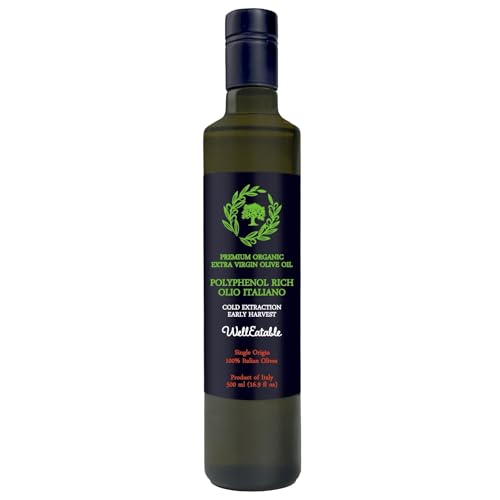 | A World Olive Center for Health certificate in its photos, analysed Nov 4, 2025, reports total polyphenols of 1,382 mg/kg. The label says 2025/2026 harvest.*2 |
| An organic bottle |  | The lowest-priced organic bottle that shows a recent harvest and proof: 500+ mg/kg, with the lab method named but no lab. Its title says 2025/26.*2 |
| An everyday bottle with good past tests |  | No harvest date on the listing; the box points to a QR code. Past tests of this brand were good, but they tested earlier bottles.*2, 6, 8, 9 |
| A lower-cost California oil |  | On the California Olive Oil Council’s 2025 list. A 2011 UC Davis test of bottles bought in 2010 found 0 of 8 failed. No harvest date on the listing.*2, 6, 14 |
Only 25 of 165 extra virgin olive oils print the year they were harvested
109 show nothing about harvest. 31 say something like “early harvest” with no year, which tells you nothing about age.*2
Olives are picked October to December in the north and May to July in the south. Count from that date. A best-by date is chosen by the seller.*3
A few bottles show a date that has already passed. In the listing photos, Colavita Premium Italian (25.5 oz glass) has a best-by of November 2021, Lucini Organic Everyday has a harvest of 2022 and a best-by of January 30, 2025, and a Kyoord bottle has a harvest of November 2023 and an enjoy-by of November 30, 2025. A listing photo can be old stock, so read the date on the bottle that arrives.*2
California Olive Ranch also sells a “Global Blend.” On its 500 mL and 750 mL bottles, the front band reads 0% California. The 100% California bottles are a different product.*2
Source: Amazon listing photos and text, Nov 19, 2026*1, 2 · Download CSV · Free to reuse with credit to Fine Print Nutrition
What counts as proof on an olive oil label
39 of the 165 bottles print a polyphenol number. Only 9 show a report from a named lab. The rest are the seller’s own numbers.*2
| What you see | What it means |
|---|---|
| A certificate from a named lab | The listing photos show a lab report with a date. 9 of the 39 bottles that print a polyphenol number show one.*2 |
| A number with its lab method | The seller reports its own result and names the method, but no outside lab. Check the harvest year beside it.*2 |
| A polyphenol number alone | Words such as "1,000+ mg/kg" with no method and no lab. Two such numbers are not always comparable.*2, 12 |
| A seal or origin mark | 21 of the 165 extra virgin listings show the North American Olive Oil Association seal, a California Olive Oil Council listing or a European protected-origin mark.*2, 13, 14 |
| A medal badge | A taste award from a competition. It does not say how old the oil is or what is in it. |
Europe lets oils with 250 mg/kg or more claim that polyphenols protect blood fats. The U.S. Food and Drug Administration has no such claim.*12
Labs use different methods and units, so compare only numbers from the same method.*6, 12
A seal covers one product, not the brand. Check the exact bottle on the seal group’s list.*13, 14
What to look for on the shelf
Five things you can check on any bottle in under a minute.*3
A harvest date. Look for a year, or a season such as 2025/26, not only a best-by date. 12 of the 165 listings keep harvest data behind a QR code or a lot code you must scan or look up, which is better than nothing but is not on the bottle.*2
Dark glass or a tin. Light and heat wear oil down. 116 of the 165 extra virgin listings are in dark glass or a tin.*2, 3
One named country. 128 of the 165 listings name a single country of origin. A bottle that lists several countries tells you less about where the olives grew.*2
A number with a lab method. A polyphenol figure is worth reading when it names how it was measured, and more when it names the lab.*2
The exact product on the seal list. A seal on the front is a claim until you find that product on the group’s own list.*13
How to keep it. Keep it away from light and heat. UC Davis says oil bought within the year of harvest may last two years if unopened, but is better used soon after purchase.*3, 4
What an extra virgin test measures
What public tests have found, and when
Every result below is dated. A result from 2011 is about the bottles bought in 2010, not about what is on the shelf today.*6
| Year | Who tested | What they found |
|---|---|---|
| 2011 | UC Davis Olive Center | Bottles bought in 2010. Of the five top imported brands, 66 of 90 samples (73%) failed both extra virgin taste panels: Pompeian 94%, Filippo Berio 83%, Bertolli 72%, Star 61%, Colavita 56%. California Olive Ranch: 0 of 18 failed. Cobram Estate: 0 of 8.*6 |
| 2012 | Consumer Reports | Only 9 of 23 oils met the extra virgin criteria. Bertolli, Filippo Berio, Mazola, Goya and Crisco tasted stale.*7 |
| 2015 | National Consumers League | 5 of 11 passed, including California Olive Ranch, Colavita and Lucini.*8 |
| 2023 | ConsumerLab | 9 of 13 oils were graded not extra virgin. Which ones is for members only.*11 |
| 2024 | Consumer Reports | Of 26 oils, California Olive Ranch Medium and an Aldi Sicilian oil stood out.*9 |
| 2024 | Industry-funded study | Of 216 shelf samples bought Sep to Dec 2024, 8 of 158 extra virgin samples (5%) failed more than one chemistry test. Brands are not named.*12 |
| 2026 | ConsumerLab | 3 of 11 failed the taste panel although all passed the chemistry tests. The 11 included three California Olive Ranch oils, Terra Delyssa, Atlas and Graza; which three failed is for members only.*10 |
Be careful with a retest. The industry-funded 2024 study notes that its samples sat an average 4.3 months between purchase and the last test, so a failure then does not prove the oil failed on the day it was bought.*12
Other brands people ask about
- Firma Signature Organic, sold as 1,000+ mg/kg; its report uses a different unit: $56.78 a liter.
- Kosterina Everyday: early harvest, no year; an award badge only: $59.98 a liter.
- Graza Sizzle: late harvest, no year; no lab or seal: $17.15 a liter.
- Partanna 3 L tin: harvest 2022/2023 on the tin in the photo; no lab or seal: $23.56 a liter.
- Atlas Organic, 1 L: no harvest date; USDA Organic: $27.94 a liter.
- Lucini Organic Everyday: harvest 2022 in the photo; USDA Organic: $35.74 a liter.
- Terra Delyssa Organic: no harvest date; a North American Olive Oil Association seal and USDA Organic: no price when read.
Brightland, Pamako and Laconiko did not appear in the 178 Amazon listings we read.*1
Download all 178 listings (CSV)
Our pick: PJ Kabos Family Reserve Medium. Check price on Amazon*1, 2
Questions people ask
What does extra virgin olive oil mean?
In the U.S. Department of Agriculture standard, extra virgin oil has excellent flavor and odor with no defects, and free fatty acids of not more than 0.8 grams per 100 grams. The grade is voluntary, so a label that says extra virgin does not mean the department checked it.*5
How old is too old?
UC Davis says to use olive oil within 15 to 18 months of the harvest and to choose the most recent harvest.*3
How should I store olive oil?
Away from light and heat. UC Davis says oil left in light or near heat loses freshness more quickly, and that extra virgin oil keeps longer at 59 F than at 77 F.*3, 4
What is a good polyphenol number?
Real bottles vary a lot, and there is no single cutoff for good. The industry-funded 2024 study found an average of 273.6 mg/kg in shelf oils, and ConsumerLab measured 200.3 to 472.8 mg/kg in 2026. Compare only numbers that name the same test method.*10, 12
What is the difference between extra virgin and light or pure olive oil?
Extra virgin is the top grade, and bottles sold as pure, light or blends are not extra virgin. 13 of the 178 listings we read were graded blend, pure or light, and we left them out of every count on this page.*2
Did Bertolli and Filippo Berio fail extra virgin tests?
UC Davis found in 2011 that 72% of the Bertolli samples and 83% of the Filippo Berio samples, all bought in 2010, failed both taste panels. Consumer Reports said Bertolli and Filippo Berio tasted stale in 2012. The newer public tests we read do not name them.*6, 7
Review log
- : Published
Notes and sources
- We found 178 listings on Amazon on Nov 19, 2026 with 8 searches. 165 are extra virgin; the rest are blends, pure or light oils. A serving is not used here: price per liter is the Amazon price divided by the liters in the listing, counting multi-packs.*1, 2
- “Prints a harvest year” means a year appears on the label or in the listing text for that bottle. Back labels are small in Amazon’s photos, so a date too small to read is counted as not shown.*2
- Polyphenol numbers are in mg/kg as printed. A range counts as its low end.*2
- The picture at the top is AI-made and shows no real product.
- We’d change our pick after a failed lab test, a label change, or when a cheaper bottle prints a recent harvest with proof. Next check: January 2027. More: which olive oils pass the lab tests, olive oils with lab-reported polyphenols, which organic olive oils are really organic, the cheapest olive oil that passes, all olive oil pages and how we check.
- Amazon US product data for olive oil (8 searches: olive oil, extra virgin, cold pressed, California, Greek, Italian, organic, high polyphenol), Nov 19, 2026: titles, brands and prices for 178 listings. Prices were read again on the build day.
- Front and back labels in the Amazon listing photos, plus the listing text, read by eye Nov 19, 2026. 165 listings are graded extra virgin. Back labels are small in Amazon photos, so a date counts only when it is visible on the label or in the listing.
- UC Davis, "How to choose the best olive oil". Harvest date, how long oil keeps, light and heat.
- UC Davis Olive Center, olive oil myths sheet. Storage temperature.
- USDA Agricultural Marketing Service, "Olive Oil and Olive-Pomace Oil Grades and Standards". The voluntary U.S. grade for extra virgin.
- UC Davis Olive Center, report on imported extra virgin olive oil sold in California, April 2011 (bottles bought Sep to Oct 2010) Samples from leading supermarkets in three California regions.
- Consumer Reports, olive oil press release, July 2012. 23 oils tested; 9 met the extra virgin criteria.
- National Consumers League, olive oil test, released May 19, 2015 (bottles bought Jan 2015; lab: Australian Oils Research Laboratory) 11 oils tested; 5 were extra virgin.
- Consumer Reports olive oil taste test, Feb 2024, as reported by Click On Detroit. 26 oils. The full ratings are for members.
- ConsumerLab, extra virgin olive oil review news release, Sep 30, 2026. The free text does not say which three failed.
- ConsumerLab, olive oil testing news release, Apr 10, 2023. The release does not name the nine.
- North American Olive Oil Association, 2024 olive oil testing study (industry-funded; run by Yale researcher Tassos Kyriakides), 216 shelf samples bought Sep to Dec 2024. Brands are not named.
- North American Olive Oil Association seal member list, read Nov 19, 2026. Members join the program; each product is certified one by one.
- California Olive Oil Council, certified oils for the 2025 harvest, read Nov 19, 2026. 49 producers are listed.