- Muscle uses energyATP, your muscle’s fuel, gives up its energy and becomes ADP.
- Creatine kinase, the enzyme that swaps themPhosphocreatine, the quick backup store, hands its phosphate to ADP. That makes ATP again. It takes a fraction of a second.
- Rebuilt at restCreatine turns back into phosphocreatine over minutes.
What does creatine do?
With weight training, creatine gives a small extra gain in strength and lean mass. It works by filling your muscles’ quick-energy store, called phosphocreatine, which remakes their fuel in the first seconds of a hard effort. Supplements raise that store by about 20% in people on a normal diet.*1–5
What will you notice if you take it?
Mostly a small extra gain in strength and lean mass over weeks, if you also train with weights. You will not feel a dose kick in.
In adults under 50, creatine plus weight training added about 1.1 kg of lean mass compared with training alone.*5 In a 2025 review of 69 studies, it added about 1.4 kg on the bench press and 5.6 kg on the squat compared with placebo. In that review the strength gains were significant in men and younger adults, not in women or older adults.*4 The lean-mass figure may include some of the water described below: the studies we read do not separate water from muscle. We did not find one standard trial length in the abstracts we read, so there is no single timeline.
Your scale weight can rise a little in the first days, because creatine draws water into your muscle cells.*15 More on water below. The store fills over days to weeks, as the chart below shows, so there is no one dose to wait for.
Brain effects are not established. The European Food Safety Authority, reviewing a creatine maker’s application, said in 2024 that a cause-and-effect link with better thinking has not been established.*17 A 2024 review of 16 trials found a small gain in memory tests but no clear gain in overall thinking.*18
Every benefit, graded from strong to not shown · How much to take, by weight and situation
Where does creatine come from?
Your body makes creatine, and meat and fish add more. The liver and kidneys build it from three amino acids: arginine, glycine and methionine.*6, 7
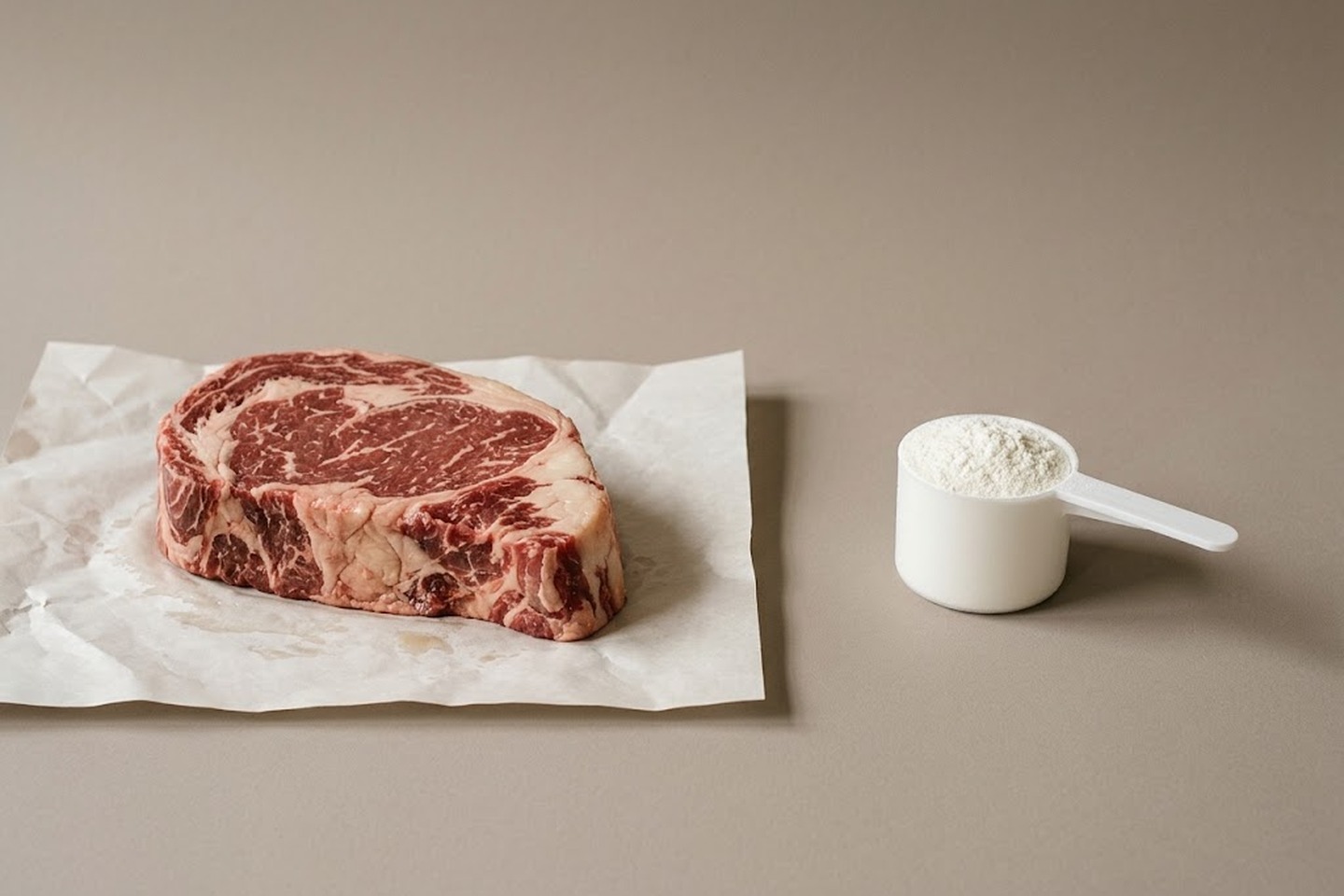
A 70 kg man needs about 2 g a day. If he eats meat, up to half of that can come from food.*7 A 5 g supplement dose equals the creatine in about 2.4 lb of raw steak.*8
Illustration, not to scale.
About 95% of your creatine sits in skeletal muscle. The rest is mostly in the brain and testes.*6 Inside muscle, about two-thirds is phosphocreatine, the form in the diagram above, and one-third is free creatine.*2, 6
You lose some every day. About 1 to 2% of the creatine in muscle breaks down and leaves in your urine, so your body has to replace about 1 to 3 g a day.*6
How much is in your muscles, and how much do supplements add?
Supplements raise muscle creatine by about 20% in people on a normal diet. Loading gets there in 6 days. Taking 3 g a day gets there in about 4 weeks.*3
Source: Hultman et al., 1996, 31 men*3 · Free to reuse with credit to Fine Print Nutrition
A typical adult store is about 120 mmol per kg of dry muscle, and the ceiling for most people is about 160.*6 On a normal diet, which gives 1 to 2 g of creatine a day, muscle is about 60 to 80% full.*6 Supplements move you toward that ceiling. Reviews put the rise at 20 to 40%. The 1996 trial we chart found about 20%.*6
People who start low gain the most. In one early study the rise reached 50% in some people.*8
Why does creatine help short, hard efforts more than long ones?
Your muscle keeps only a small amount of fuel on hand. Phosphocreatine is a quick backup store right beside it that tops the fuel up fast.
That makes it the fastest way for muscle to remake ATP, the fuel. But the store is small, so it matters most in the first seconds. It can hold up to 10 times as much as the fuel itself.*2
In an all-out effort of up to 5 to 6 seconds, phosphocreatine does most of the work. After that, other systems take a larger share. Glycolysis, which breaks down sugar, does not reach its top speed until about 10 to 15 seconds in.*1
A 30-second sprint drained the store fast, and it refilled slowly.
Source: Baker et al., 2010, reporting an earlier sprint study*1 · Free to reuse with credit to Fine Print Nutrition
Why do vegetarians respond more?
Vegetarians start with less creatine in their muscles, so there is more room to fill. Animal foods are the main dietary source, and vegans get none from food.*6, 7
An 8-week trial put 18 vegetarians and 24 meat eaters on weight training. Vegetarians started lower, at 117 mmol per kg against 130.*10 Vegetarians who took creatine gained more creatine, more phosphocreatine and more lean tissue than meat eaters who took it. The size of the rise tracked the starting level.*10
Does creatine reach the brain?
A little. Supplements raise brain creatine by about 5 to 10%, against about 20 to 40% in muscle.*11
Source: Antonio et al., 2025 (part II)*11 · Free to reuse with credit to Fine Print Nutrition
Reviews suggest two reasons. The brain makes its own creatine, and few transporters carry creatine across the blood-brain barrier.*11, 12
In 6 healthy adults who took 20 g a day for 4 weeks, brain creatine rose 8.7% on average, from 3.5% to 13.3% depending on the person. It was back to the starting level 3 months after they stopped.*13 In 15 adults who took creatine for 7 days it rose 9.2% on average.*14 A recent review found no clear link between dose, time and the size of the rise.*11
Does creatine make you hold water?
A little, early on. Creatine draws water into muscle cells, so body weight can rise in the first days.*15 In sprint studies that gave about 20 g a day for 3 to 7 days, body mass rose 0.79 kg on average.*9
Over longer trials, 5 to 10 weeks of training, several found no significant change in total body water.*15 In an 8-week trial of 27 trained men, water inside muscle cells rose more with creatine, but the ratio of that water to muscle mass did not change.*16
What do people get wrong about creatine?
| The myth | What the sources say |
|---|---|
| “It’s a steroid.” | No. Creatine has a completely different chemical structure. Anabolic steroids are synthetic forms of testosterone, and they are controlled substances.*15 |
| “It’s a lab chemical, not natural.” | Your body makes it from three amino acids, and meat and fish contain it.*6, 7 |
| “It shuts down your own production.” | No evidence of this. After people stop, muscle creatine does not fall below where it started.*6 |
| “It’s only for men.” | No. The International Society of Sports Nutrition review says creatine has the potential to help women across the lifespan.*15 One 2025 review found the strength gain was not significant in women, so the evidence there is weaker.*4 |
| “Other forms beat plain monohydrate.” | Not shown. The same group says no other form has been shown to beat monohydrate. Its authors have ties to creatine makers. Our forms page compares them.*15 |
What does this mean if you take it?
- Take 3 to 5 g of creatine monohydrate a day. Taking it every day matters more than the time of day. Doses by weight and situation are on our creatine dose page.*6, 19
- Expect it to build up. Your muscles fill over days to weeks, as the chart above shows. Take it every day and give it time.
- Plain monohydrate is the form the studies used. Our forms page compares it with capsules, HCl and micronized.
Questions people ask
- What does taking creatine actually do?
- It tops up the reserve your muscles use to remake ATP in the first seconds of a hard effort. The store ends about 20% higher after a few weeks of daily use, or after a week of loading.*2, 3
- How does creatine work in the body?
- Muscle spends ATP and is left with ADP. An enzyme, creatine kinase, moves a phosphate from phosphocreatine to ADP and makes ATP again. That takes a fraction of a second. At rest, creatine is turned back into phosphocreatine over minutes.See the diagram.*1, 2
- What happens after one month of creatine?
- After a month at 3 g a day, muscle creatine was about 20% above where it started in the 1996 trial. Loading gave the same rise in 6 days. Body weight can be a little higher early on, because muscle holds more water.*3, 15
- Do I need creatine if I take protein?
- They do different jobs. Protein supplies amino acids to build and repair tissue. Creatine is made from three amino acids and stores quick energy in muscle. Protein does not do that job.*6
- Is creatine natural?
- Yes. Your liver and kidneys make it from three amino acids, and meat, fish and milk contain it.*6, 7
- Does creatine make you retain water?
- A little, early on. In longer trials, total body water often did not change.More above.*9, 15
- Does creatine work for the brain?
- It raises brain creatine by about 5 to 10%. Whether that helps thinking is mixed.More above.*11, 18
- How effective is creatine?
- With training, it gives a small, steady edge in strength and lean mass. For thinking, the results are mixed.The numbers are above. Every benefit, graded.*4, 5, 18
- Is creatine safe?
- In healthy adults, yes at recommended doses, say the expert papers. The ISSN position stand calls up to 30 g a day for 5 years safe and well tolerated in healthy people, and says recommended doses do not damage healthy kidneys. These are statements by the ISSN, whose authors have ties to creatine makers. If you have kidney disease, ask your doctor first.*6, 15
- What are the different types of creatine?
- Monohydrate is the most studied. The International Society of Sports Nutrition says no other form has been shown to beat it, and its papers have authors with ties to creatine makers. Our forms page compares powder, capsules, HCl and micronized.*15, 20
Review log
- : Published
Notes and sources
- How we built this: we read 18 papers, 6 human trials and 12 reviews, meta-analyses or expert reports. We checked each title, year, journal, PMID and DOI against PubMed on October 22, 2026. We ran no tests. Where we read only the abstract, the source list says so.
- The diagram is a simplified drawing, not to scale. Our timing numbers (5 to 6 seconds, and the recovery times) come from one review, Baker 2010. We have not yet matched them to a second source.
- The chart shows each person’s muscle creatine relative to their own start. The 1996 trial gave “about 20%” and “back to baseline in about 30 days”. The abstract does not give the muscle values before and after, so we do not print any.
- A typical store of about 120 mmol per kg of dry muscle is an average for a 70 kg adult. The measured rise in people on a normal diet is about 20%. Reviews say 20 to 40%. We did not claim most people reach the 160 ceiling.
- The 20 to 40% rise and the 160 ceiling in the reviews are rough and do not line up exactly: a 40% rise on a start of 120 would pass 160. Treat both as ranges.
- The vegetarian trial (117 against 130 mmol per kg) used its own method. Other studies report different absolute values, so compare the gap inside one study, not numbers across studies.
- We left out some figures that are repeated online because we could not trace them to a paper we read: a total of about 120 g of creatine in the body, an exact grams-a-day figure for how much your body makes on its own, a figure for how much leaves in urine each day, and the claim that creatine fuels the first 10 seconds of effort. The sources we read support 5 to 6 seconds for the stretch where phosphocreatine does most of the work.
- Funding and ties: the two main reviews we lean on, the International Society of Sports Nutrition position stand and its question-and-answer papers, have authors with creatine-industry ties. A few numbers come only from these reviews: the typical store, the 160 ceiling, the daily loss and the share of creatine in muscle. Each source below lists what we found about its funding. Next check: January 2027.
- The diagram and the chart are our own drawings. They are free to reuse with credit to Fine Print Nutrition. The steak and scoop picture is an illustration (generated image), not a photo.
- Baker JS et al. Interaction among Skeletal Muscle Metabolic Energy Systems during Intense Exercise. J Nutr Metab 2010. PMID 21188163. DOI 10.1155/2010/905612. We read the full paper. Funding not checked. This is the only source for our timing numbers.
- Wallimann T et al. The creatine kinase system and pleiotropic effects of creatine. Amino Acids 2011. PMID 21448658. DOI 10.1007/s00726-011-0877-3. We read the full paper. Funding not checked.
- Hultman E et al. Muscle creatine loading in men. J Appl Physiol (1985) 1996. PMID 8828669. DOI 10.1152/jappl.1996.81.1.232. We read the abstract only. Funding not stated in the abstract. The abstract gives “about 20%” but not the muscle values before and after.
- Kazeminasab F et al. The Effects of Creatine Supplementation on Upper- and Lower-Body Strength and Power: A Systematic Review and Meta-Analysis. Nutrients 2025. PMID 40944139. DOI 10.3390/nu17172748. We read the abstract only. Funding not stated in the abstract.
- Desai I et al. The Effect of Creatine Supplementation on Resistance Training-Based Changes to Body Composition: A Systematic Review and Meta-analysis. J Strength Cond Res 2024. PMID 39074168. DOI 10.1519/JSC.0000000000004862. We read the abstract only. Funding not stated in the abstract.
- Kreider RB et al. International Society of Sports Nutrition position stand: safety and efficacy of creatine supplementation in exercise, sport, and medicine. J Int Soc Sports Nutr 2017. PMID 28615996. DOI 10.1186/s12970-017-0173-z. We read the full paper. Several authors report industry roles or creatine-industry grants and consulting. Manuscript preparation was paid for by the Council for Responsible Nutrition, a trade group.
- Brosnan ME et al. The role of dietary creatine. Amino Acids 2016. PMID 26874700. DOI 10.1007/s00726-016-2188-1. We read the abstract only. Funding not checked.
- Harris RC et al. Elevation of creatine in resting and exercised muscle of normal subjects by creatine supplementation. Clin Sci (Lond) 1992. PMID 1327657. DOI 10.1042/cs0830367. We read the abstract only. Funding not stated in the abstract.
- Glaister M et al. Short-Term Creatine Supplementation and Repeated Sprint Ability-A Systematic Review and Meta-Analysis. Int J Sport Nutr Exerc Metab 2022. PMID 36041731. DOI 10.1123/ijsnem.2022-0072. We read the abstract only. Funding not checked.
- Burke DG et al. Effect of creatine and weight training on muscle creatine and performance in vegetarians. Med Sci Sports Exerc 2003. PMID 14600563. DOI 10.1249/01.MSS.0000093614.17517.79. We read the abstract only. Funding not stated in the abstract.
- Antonio J et al. Part II. Common questions and misconceptions about creatine supplementation: what does the scientific evidence really show?. J Int Soc Sports Nutr 2025. PMID 39720835. DOI 10.1080/15502783.2024.2441760. We read the full paper. The ISSN’s chief executive is an author, and the ISSN says it gets support from companies that make or sell creatine. Several authors sit on the advisory board of AlzChem, which makes Creapure. One author previously worked for a creatine-selling company.
- Candow DG et al. "Heads Up" for Creatine Supplementation and its Potential Applications for Brain Health and Function. Sports Med 2023. PMID 37368234. DOI 10.1007/s40279-023-01870-9. We read the full paper. One author has done industry-sponsored creatine research and sits on AlzChem’s advisory board.
- Dechent P et al. Increase of total creatine in human brain after oral supplementation of creatine-monohydrate. Am J Physiol 1999. PMID 10484486. DOI 10.1152/ajpregu.1999.277.3.R698. We read the abstract only. Funding not checked. The abstract says 6 adults; one later review says 9, and we used the abstract.
- Turner CE et al. Creatine supplementation enhances corticomotor excitability and cognitive performance during oxygen deprivation. J Neurosci 2015. PMID 25632150. DOI 10.1523/JNEUROSCI.3113-14.2015. We read the abstract only. Funding not checked.
- Antonio J et al. Common questions and misconceptions about creatine supplementation: what does the scientific evidence really show?. J Int Soc Sports Nutr 2021. PMID 33557850. DOI 10.1186/s12970-021-00412-w. We read the full paper. The ISSN’s chief executive is an author, and the ISSN says it gets support from companies that make or sell creatine. Several authors sit on the advisory board of AlzChem, which makes Creapure.
- Ribeiro AS et al. Creatine Supplementation Does Not Influence the Ratio Between Intracellular Water and Skeletal Muscle Mass in Resistance-Trained Men. Int J Sport Nutr Exerc Metab 2020. PMID 32916658. DOI 10.1123/ijsnem.2020-0080. We read the abstract only. Funding not checked.
- EFSA Panel on Nutrition, Novel Foods and Food Allergens. Creatine and improvement in cognitive function: Evaluation of a health claim pursuant to article 13(5) of regulation (EC) No 1924/2006. EFSA J 2024. PMID 39564533. DOI 10.2903/j.efsa.2024.9100. We read the abstract only. The panel was reviewing an application from AlzChem, a creatine maker, and found that a cause-and-effect link was not established.
- Xu C et al. The effects of creatine supplementation on cognitive function in adults: a systematic review and meta-analysis. Front Nutr 2024. PMID 39070254. DOI 10.3389/fnut.2024.1424972. We read the abstract only. The authors declare no conflicts. A correction was published; we did not read what it changed.
- Fine Print Nutrition, “How much creatine per day should you take?” (doses, loading and timing)
- Fine Print Nutrition, “Creatine powder, capsules or HCl: which should you take?”