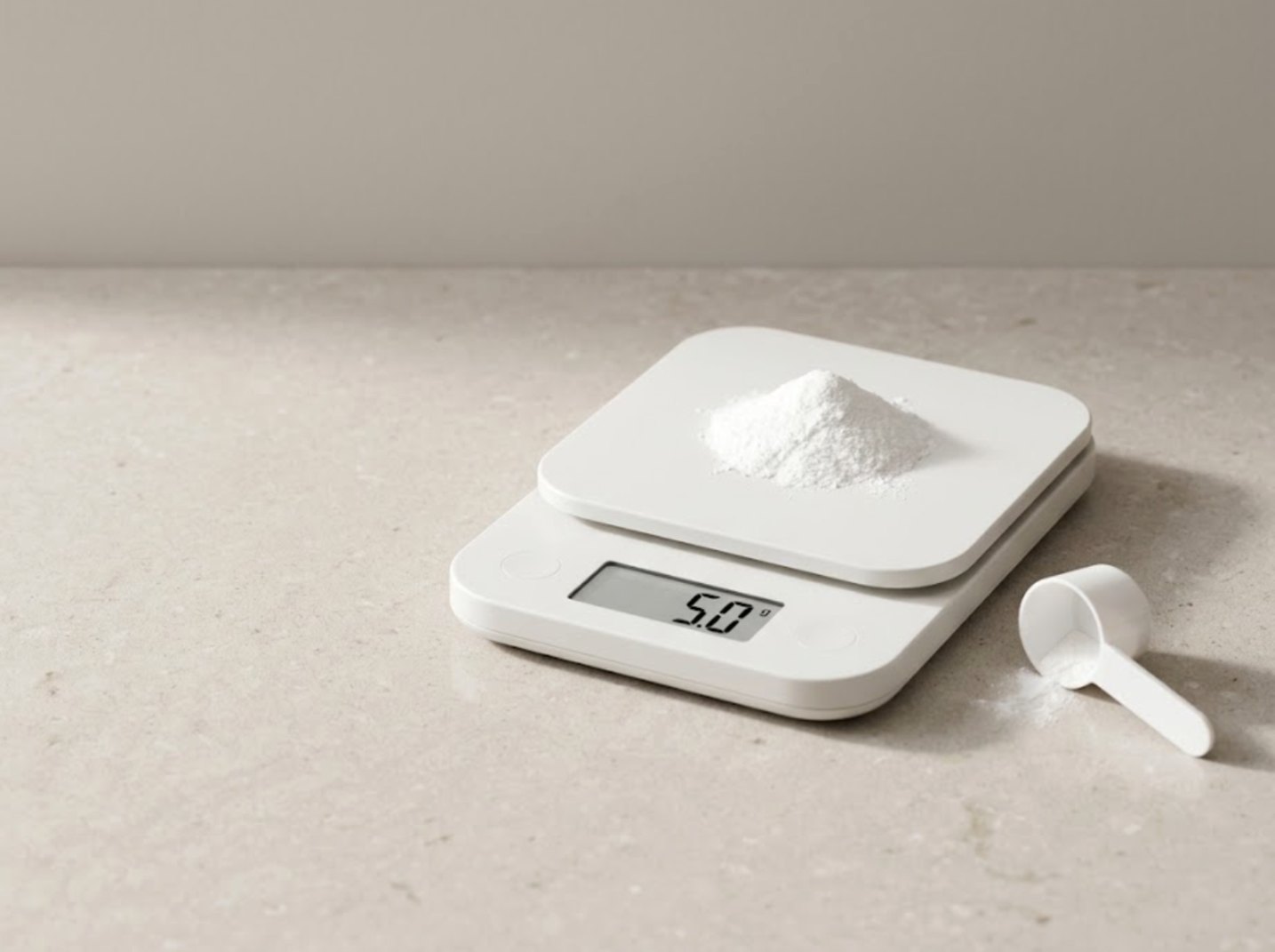
When should you take a different amount?
Doses are for creatine monohydrate, the standard form almost all studies used.*1 Wondering why a daily dose matters? See how creatine works in your muscles.
| If this is you | Daily dose | Why |
|---|---|---|
| Most adults | 5 g a day | The dose most trials used. 3 g a day also works, but takes about 4 weeks to fill your muscles.*1, 4 |
| Over about 200 lb (90 kg), or very muscular | Up to 10 g a day, as two 5 g doses | No trial compared doses by body size. The International Society of Sports Nutrition (ISSN) says larger athletes in hard training may need 5 to 10 g.*1, 21 |
| You want it working in about a week | 20 g a day as four 5 g doses for 5 to 7 days, then 5 g a day | This "loading" fills muscles in about 6 days instead of about 4 weeks. It's optional.*1, 4 |
| Women | Same 5 g a day | We found no study showing women need a different dose.*5 |
| Over 50 | Same 5 g a day, plus strength training | Trials found the muscle gains when creatine was paired with lifting. Some trials in older adults used more, about 0.1 g per kg (7 g at 70 kg).*6, 7 |
| Vegetarians and vegans | Same 5 g a day | You start with less creatine in your muscles, so you may gain more.*8 |
| Brain and memory | No proven dose | Memory trials used 2 to 20 g a day. Two reviews found small memory gains, and the EU food safety agency rejected a claim that creatine improves thinking.*9–11 |
| Kidney disease, pregnant, under 18, or on prescription drugs | Ask your doctor first | Safety studies were mostly in healthy adults.*1, 3 |
How do you get 5 g from what you bought?
The 5 g rule is for creatine monohydrate. We read the labels of 16 top creatine products on Amazon. 11 give 5 g in one serving. The rest give less, so check yours.
| Form | 5 g is | Watch for |
|---|---|---|
| Powder | 1 scoop on most labels | All 7 monohydrate powders we checked give 5 g per serving. Use the scoop. Teaspoons vary: our pick says 2 level teaspoons is about 5 g.*23 |
| Capsules | 4 to 7 capsules, depending on the brand | Some brands call less than 5 g a serving: Optimum Nutrition: 2 capsules = 2.5 g and Nutricost: 4 capsules = 3 g. Count to 5 g, not to one serving.*23 |
| Gummies | 2 to 5 gummies, by brand | In lab tests, many gummy brands held far less than their label. See which gummies held their dose.*17 |
| Creatine HCl | No studied dose | A 750 mg serving holds about 13% as much creatine as 5 g of monohydrate. HCl brands say it absorbs better, but we found no study showing a smaller dose works as well.*16, 23 |
Source: Supplement Facts panels and listings, checked October 18, 2026*16, 23 · Download CSV · Free to reuse with credit to Fine Print Nutrition
Our pick for creatine powder

BulkSupplements Creatine Monohydrate Powder
| Lab test | 99% of label (SuppCo, June 2025)*19 |
|---|---|
| Certification | NSF Certified for Sport*20 |
| One dose | 2 level teaspoons (about 5 g) for $0.14*23 |
Why this one. It met its label in an independent test, it's NSF Certified for Sport, and it's the cheapest powder with both. See every monohydrate powder with proof of its 5 g. See how we picked it, or our gummy pick if you won't take powder.*18
How much creatine should you take by body weight?
For most people, 5 g. Sources use three different rules, which is why the numbers you see don't match. At 70 kg they give 3 to 7 g a day. At 100 kg they give 3 to 10 g.
| Rule and where it comes from | 70 kg (154 lb) | 100 kg (220 lb) |
|---|---|---|
| A flat 3 to 5 gISSN and most health sites | 3 to 5 g | 3 to 5 g*1, 22 |
| 5 g, or 10 g near 200 lb and upUniversity of Rochester Medical Center | 5 g | 10 g*21 |
| 0.1 g per kgTrials in older adults | 7 g | 10 g*2, 7 |
Do you need a loading phase?
No. Loading only gets you there faster. Both routes end at the same muscle creatine level.*1, 4
| Plan | Muscles full in |
|---|---|
| Loading20 g a day for 5 to 7 days, then 5 g | About 6 days |
| No loading3 to 5 g a day from the start | About 4 weeks |
Source: ISSN position stand (Kreider et al., 2017); Hultman et al., 1996*1, 4
How much creatine is too much?
We found no official upper limit. The ISSN describes up to 30 g a day for 5 years as safe in healthy adults.*1 A 2026 review of 684 trials found side effects stayed small at higher doses and over longer times.*13 Authors of both have ties to creatine makers.
The practical limit is your stomach. In one trial, a single 10 g dose caused diarrhea in 56% of soccer players, against 29% when it was split into two 5 g doses.*12 Creatine can also raise creatinine, a waste marker doctors use to check your kidneys, so tell your doctor you take it.*2
Questions people ask
- Is 10 g of creatine a day too much?
- Not for healthy adults, based on current studies, which have used up to 30 g a day for 5 years. But in one trial a single 10 g dose doubled diarrhea, so split it into two 5 g doses.*1, 12
- Is 5 g of creatine enough to build muscle?
- Yes, for most adults. In a classic trial, even 3 g a day filled muscle creatine stores in about 4 weeks, so 5 g does too. The muscle gains in trials came when creatine was paired with strength training.*4, 6
- How much creatine should a 70 kg man take?
- 5 g a day. The rules sources use give 3 to 7 g for a 70 kg person, and 5 g sits in that range.*1, 2, 4
- Does it matter what time I take creatine?
- Not much. Take it any time you will remember, with or without food. Taking it every day matters more than when.*3
- What happens if I miss a day or stop?
- We found no study on missed doses. Muscle creatine builds and falls over weeks, so one missed day should matter little. If you stop, levels drift back to normal over about 4 to 6 weeks.*1, 4
- Can I take creatine with my medications?
- Ask your doctor or pharmacist first, and bring the product so they can read the label. We don't give advice on specific drugs.*1, 2
- How much creatine do you get from food?
- About 1 g a day from a typical diet. Raw beef has about 0.5 g per 100 g. Vegans get almost none from food.*14, 15
Review log
- Prices and stock checked on Amazon October 22, 2026.
- : Published
Notes and sources
- We read the studies behind each dose and checked every PubMed ID against its title (October 18, 2026). This page isn't medical advice.
- ISSN is the International Society of Sports Nutrition. Its 2017 position stand is the main summary of creatine dosing research.*1
- Label servings: we read the Supplement Facts panel or listing of 16 top Amazon creatine products. Creatine in one serving is compared with the creatine in 5 g of monohydrate (4.4 g), using PubChem molecular weights. One gummy listing (Legion) gives a 5 g serving without a gummy count.*16, 23
- Food: a typical US diet supplies about 15.5 mg per kg of body weight a day, about 1.1 g at 70 kg (our arithmetic). Raw beef has about 5 g per kg.*14, 15
- Next check: January 2027. The hero photo is an illustration. The product photo comes from Amazon.
- Kreider RB et al. ISSN position stand on creatine. J Int Soc Sports Nutr 2017. PMID 28615996 Several creatine review authors disclose ties to creatine makers.
- Antonio J et al. Common questions and misconceptions about creatine supplementation. J Int Soc Sports Nutr 2021. PMID 33557850
- Antonio J et al. Part II. Common questions and misconceptions about creatine supplementation. J Int Soc Sports Nutr 2025. PMID 39720835
- Hultman E et al. Muscle creatine loading in men. J Appl Physiol 1996. PMID 8828669
- Smith-Ryan AE et al. Creatine supplementation in women's health: a lifespan perspective. Nutrients 2021. PMID 33800439
- Chilibeck PD et al. Creatine during resistance training in older adults: a meta-analysis. 2017. PMID 29138605
- Forbes SC et al. Creatine ingestion strategies in older adults: a meta-analysis. Nutrients 2021. PMID 34199420
- Burke DG et al. Creatine and weight training in vegetarians. Med Sci Sports Exerc 2003. PMID 14600563
- Xu C et al. Creatine and cognitive function in adults: systematic review and meta-analysis. 2024. PMID 39070254
- Prokopidis K et al. Creatine and memory: systematic review and meta-analysis. Nutr Rev 2023. PMID 35984306
- EFSA NDA Panel. Creatine and improvement in cognitive function: evaluation of a health claim. 2024. PMID 39564533
- Ostojic SM, Ahmetovic Z. Gastrointestinal distress after creatine supplementation in athletes: are side effects dose dependent? Res Sports Med 2008. PMID 18373286
- Gonzalez DE et al. Creatine dose and duration are not associated with increased side effects: review of RCTs. 2026. PMID 42043069 Authors disclose industry ties.
- Nedeljkovic D, Ostojic SM. Dietary exposure to creatine-precursor amino acids in the general population. Amino Acids 2025. PMID 40413365
- Ávila M et al. Creatinine metabolism and kidney function in clinical practice (food creatine table from Balsom 1994). 2025. PMID 39858438
- PubChem: creatine (CID 586), creatine monohydrate (CID 80116), creatine hydrochloride (CID 134732) molecular weights Percentages are our arithmetic from molecular weights.
- Fine Print Nutrition, "Do creatine gummies actually have the creatine they claim?" (25 lab-tested brands)
- Fine Print Nutrition, "Creatine gummies vs powder" (powder lab tests and prices)
- SuppCo, "SuppCo Tested: Creatine" report, June 12, 2025 (PDF) The lab is not named.
- NSF Certified for Sport listing: Bulk Supplements Creatine Monohydrate Powder Unflavored, checked Oct 18, 2026
- University of Rochester Medical Center, "Creatine for Beginners: Should You Take It?" Health Matters, Feb 23, 2026
- Harvard Health Publishing, "What is creatine? Potential benefits and risks of this popular supplement," 2024
- Amazon.com listing prices and Supplement Facts panels, read Oct 18, 2026